[language-switcher]

7 Blue Light Therapy Buying Tips for Global Buyers

Buying Blue Light Therapy equipment across borders requires more than comparing prices and glossy product photos. Global buyers must examine wavelength, irradiance, treatment area, device safety, and supplier reliability. A panel showing 415 nanometers may suit acne-focused research, while other applications may require different specifications. The numbers matter. So does the testing behind them.

This guide shares seven practical buying tips for distributors, clinics, retailers, and informed consumers. It explains how to read technical sheets, verify certifications, review warranty terms, and assess shipping risks. A credible supplier should provide traceable test reports, clear user instructions, and realistic performance claims. Marketing language alone is not enough. Ask for evidence.

Small details often reveal quality. Check the power adapter’s plug type, cable length, cooling design, and replacement policy. Confirm whether the product is designed for home use, professional use, or both. Imported devices may also face different labeling and conformity requirements in each market. Local compliance should be checked before purchase.

No checklist is perfect. I have seen buyers focus on light color and ignore dosage consistency. That mistake can become expensive. A lower-priced device may need frequent replacement or lack responsive technical support. Compare the complete ownership cost, not only the invoice total. With careful questions and modest skepticism, buyers can choose Blue Light Therapy products more safely and confidently.
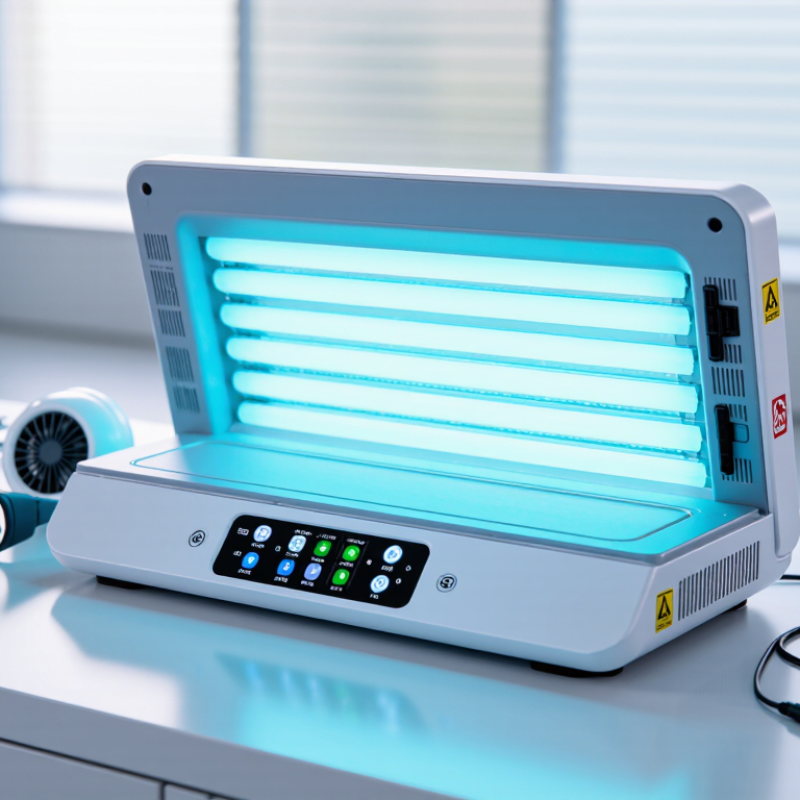
7 Blue Light Therapy Buying Tips for Global Buyers

Understand the Basics of Blue Light Therapy Before Buying

Blue light therapy usually means visible light near 400–500 nanometres. Acne devices often target wavelengths around 415 nanometres. Unlike ultraviolet light, blue light is not ionising, but it still needs sensible exposure control. The American Academy of Dermatology notes that visible-light devices may help some inflammatory acne, while evidence remains limited. A Cochrane review also found inconsistent results across light-based acne studies.

Results are not guaranteed.

Tip 1: Identify the treatment goal. Acne, skin appearance, and circadian support require different wavelengths and schedules. Do not assume one panel suits every purpose.

Tip 2: Check the technical sheet. Look for wavelength, irradiance, treatment distance, session time, and eye-safety instructions. IEC 62471 provides a recognised framework for assessing photobiological lamp safety. Missing numbers are a warning sign.

Tip 3: Ask for independent test evidence, not only marketing claims. The Global Wellness Institute valued the wellness economy at about 6.3 trillion dollars in 2023, showing strong market growth, not proven clinical effectiveness.

Tip 4: Review contraindications carefully. Photosensitising medicines, eye conditions, or light-sensitive disorders may require medical advice.

Tip 5: Compare maintenance needs, warranty terms, and replacement parts before buying.

Tip 6: Keep treatment records with dates and skin reactions.

Tip 7: Start conservatively. More light is not automatically better. I would still question impressive before-and-after images, because lighting, skincare, and editing can change the result.

Define Your Treatment Goals and Match the Right Device Type

Before comparing price or appearance, define what you want the device to do. Blue light devices differ by wavelength, treatment area, intensity, and intended use. A person targeting occasional blemishes may prefer a small handheld unit for precise areas. Someone seeking broader skin coverage may find a face mask more practical. For larger body areas, a panel can save time, but it needs careful positioning and suitable eye protection.

Be specific about your routine. Will you treat one spot for ten minutes, or several areas each week? Check the treatment instructions, recommended distance, timer, and cleaning method.

A device with adjustable settings may seem convenient, yet complicated controls can reduce consistent use. Keep it simple. Look for clear technical data, safety testing, user instructions, and support that explains realistic outcomes. Marketing language alone is not evidence.

Your health history also matters. Photosensitive medicines, eye conditions, or certain skin disorders may require professional advice before use. Do not assume stronger light means faster results. It may increase irritation or discomfort. In practical evaluations, comfort and repeatability often matter more than impressive specifications. I would also question devices that hide wavelength information or promise universal results. The right choice is not always the most powerful one.

Compare Light Wavelength, Intensity, Coverage, and Treatment Area

A useful buying comparison starts with wavelength, not appearance. Blue light devices commonly operate between 400 and 500 nanometers. For acne-focused use, published clinical research often examines wavelengths near 415 nanometers. However, results vary with skin type, exposure schedule, and treatment quality. A 2023 systematic review in Dermatologic Therapy reported promising outcomes, but also noted inconsistent study designs. The evidence is useful, not perfect.

Intensity needs careful reading. Manufacturers may list irradiance in milliwatts per square centimeter, yet some reports show only electrical power. These values are not interchangeable. Calculate dose by multiplying irradiance by treatment time. For example, 10 mW/cm² for 10 minutes provides about 6 J/cm². Ask for independent measurements at the skin surface. IEC 62471 evaluates photobiological safety, while ICNIRP guidance addresses blue-light exposure risks. Safety data should accompany performance claims.

Coverage matters when treating uneven areas. A narrow panel may deliver strong light to the center, while the cheeks receive less. Check the treatment area, working distance, and irradiance map. A larger coverage zone can reduce repositioning time. It can also create weaker edges. That trade-off is easy to miss. Look for testing across the full treatment field, not only its brightest point. Protective eyewear and clear usage limits remain important, especially near the 400–450 nanometer range. A higher intensity is not automatically better.

7 Blue Light Therapy Buying Tips for Global Buyers - Compare Light Wavelength, Intensity, Coverage, and Treatment Area
Tip Buying Dimension What to Compare Practical Reference Range Why It Matters Buyer Checklist
1 Light Wavelength Peak wavelength and spectral bandwidth For visible blue-light devices, commonly stated peak wavelengths are approximately 405–470 nm. Products should disclose the peak wavelength and whether the output is narrow-band or broad-spectrum. Wavelength affects how light interacts with the skin and eyes. A small difference in wavelength can change the intended application and the required safety assessment. Request a spectral report, peak wavelength tolerance, bandwidth, and independent verification rather than relying only on the product name.
2 Irradiance and Intensity Optical power density at the actual treatment distance Irradiance is usually reported in mW/cm². Compare measurements at the user's stated distance, because intensity generally decreases as the distance from the light source increases. Irradiance determines how much power reaches each square centimetre. A higher number is not automatically better; excessive exposure may increase glare, heat, or safety risk. Check test distance, measurement method, uniformity across the treatment area, adjustable intensity settings, and whether protective eyewear is required.
3 Dose and Treatment Time Energy density, exposure duration, and timer control Energy density is calculated as: J/cm² = irradiance (W/cm²) × time (seconds). For example, 10 mW/cm² applied for 10 minutes equals approximately 6 J/cm². Comparing irradiance alone can be misleading. The delivered dose depends on both light intensity and exposure time. Confirm the stated dose, session duration, timer accuracy, automatic shut-off, and whether the instructions define a safe maximum daily exposure.
4 Coverage and Uniformity Illuminated area, edge-to-edge consistency, and distance tolerance Compare the effective illuminated area in cm² or the dimensions of the light-emitting surface. Ask for irradiance mapping, especially at the center and edges. Uneven coverage can produce underexposed and overexposed areas, making results less consistent across the treatment zone. Request a coverage map, recommended positioning distance, beam angle, diffuser details, and performance data for curved or uneven surfaces.
5 Treatment Area and Form Factor Target body area, device size, flexibility, and positioning Small spot devices are suited to localized areas, while larger panels or flexible masks can cover broader areas. The useful size should be judged by the actual treatment zone, not only by the external product dimensions. A device that matches the treatment area can reduce repositioning, shorten sessions, and improve repeatability. Compare active light-emitting area, contact or stand-off design, hands-free operation, portability, cable length, and compatibility with the intended body location.
6 Eye, Skin, and Electrical Safety Optical safety, heat management, materials, and market compliance Blue light can produce glare and may present retinal or photosensitivity concerns depending on wavelength, intensity, duration, and user condition. A compliant device should provide clear warnings, instructions, and electrical safety information. Risk depends on the complete exposure conditions, not wavelength alone. Users with photosensitivity, certain eye conditions, or photosensitizing medicines may need professional advice before use. Check documented photobiological safety testing, protective eyewear guidance, thermal controls, electrical certifications for the destination market, and contraindications.
7 Global Usability and Documentation Voltage, plug type, language support, warranty, and technical transparency Confirm whether the power supply supports the destination voltage, commonly 100–240 V AC, 50/60 Hz, and whether the correct plug adapter or cable is supplied. Requirements vary by country. Proper electrical compatibility and complete documentation reduce installation problems, returns, customs delays, and incorrect use in international markets. Request multilingual instructions, technical drawings, test reports, warranty terms, replacement-part availability, customs documentation, and after-sales support details.
Important purchasing note: The figures above are general comparison references, not universal treatment instructions. Buyers should verify the complete technical specification, intended use, safety testing, regulatory requirements, and professional guidance applicable in the destination market.

Evaluate Safety Features, Certifications, and User Comfort

Global buyers should treat safety evidence as a purchasing requirement, not a marketing extra. Check whether the device has been tested under IEC 62471, the international standard for photobiological safety. Its risk-group result should match the intended skin area, treatment distance, and session length. Ask for the full laboratory report, not only a certificate number. CIE 244:2021 emphasizes that optical risk depends on spectrum, intensity, distance, and exposure time.

Review the operating instructions carefully. They should state irradiance, wavelength range, recommended session duration, eye-protection requirements, and contraindication warnings. A clear technical file is a strong trust signal. However, certification does not prove that every user will experience the same result. That point is often missed. Prefer products with independent electrical-safety testing and traceable calibration records. Reports should identify test methods and laboratory accreditation.

User comfort affects safe, consistent use. Look for adjustable straps, stable positioning, low heat, quiet operation, and controls that remain readable during treatment. The International Commission on Non-Ionizing Radiation Protection recommends managing exposure through measured limits and practical controls. Therefore, automatic timers and brightness settings are useful safeguards. Check whether the light reaches the target evenly; hot spots can create discomfort. User testing matters, but it can be imperfect. A 2023 review in Photodermatology, Photoimmunology & Photomedicine also indicates that evidence quality varies across light-based therapies, so buyers should avoid dramatic claims. Compare test reports, clinical evidence, warranty terms, and post-sale support before ordering internationally.

7 Blue Light Therapy Buying Tips for Global Buyers

Evaluate safety features, certifications, and user comfort before comparing price or performance claims.

This 100-point checklist gives the greatest weight to safety and treatment transparency. Buyers should verify the stated blue-light wavelength, irradiance, exposure time, eye protection, electrical safety documentation, applicable market certifications, and overall wearing comfort. Certification requirements vary by destination market, so documentation should be checked against local regulations.

Check Supplier Reliability, Pricing, Warranty, and Global Shipping

Global buyers need more than a bright product photo when choosing blue light therapy equipment. Supplier reliability matters first.

Tip 1: Request a registered company name, factory address, and recent quality records. Tip 2: Ask for test reports that match your destination market. Documents should be current and verifiable. A video factory tour can help, but it is not proof by itself. I once trusted polished samples too quickly. That was a mistake.

Tip 3: Compare complete pricing, not only the unit cost. Include accessories, packaging, payment fees, customs charges, and delivery. Tip 4: Ask whether the quotation is valid for a fixed period. Currency changes can affect your budget. Very low prices deserve careful questions.

Tip 5: Confirm the warranty in writing. Check its length, covered parts, repair process, and return shipping responsibility. “Warranty included” is too vague. Get details.

Tip 6: Review global shipping options before placing an order. Ask about delivery time, tracking, insurance, customs paperwork, and destination restrictions. Delivered-duty-paid shipping may be convenient, but verify what it really covers.

Tip 7: Order a sample before a large purchase. Test the controls, light output, packaging, and instructions in real use. Keep written communication and inspection photos. A small trial costs more today, yet it can prevent an expensive surprise later. Supplier responsiveness also matters. Slow replies often become slower support.

Inquiry Form