[language-switcher]

China Top Lab Workstations Manufacturers and Suppliers

China has become an important sourcing market for laboratory furniture, including modular Lab Workstations, mobile benches, and specialized technical stations. Manufacturers and suppliers now serve universities, pharmaceutical facilities, hospitals, testing centers, and industrial research laboratories. Their capabilities vary widely, however. A polished catalog does not always prove reliable engineering.

Dr. James A. Kaufman, founder of the Laboratory Safety Institute, has said, “Safety is not a gadget but a state of mind.” This principle remains highly relevant when evaluating Lab Workstations. A dependable workstation should support safe movement, stable equipment placement, controlled cable routing, and practical cleaning routines. Its frame should resist vibration. Its work surface should match the chemicals, instruments, and temperature conditions used daily.

This guide examines China’s leading Lab Workstations manufacturers and suppliers through a practical purchasing lens. It considers material quality, load capacity, ergonomic design, customization, production experience, quality control, and after-sales communication. Details matter. Look for documented testing, clear product drawings, traceable materials, and realistic delivery commitments.

Some suppliers offer excellent customization. Others depend heavily on outsourced components. That difference may remain hidden until installation. Buyers should request samples, factory evidence, and reference projects before placing large orders. Certification alone is not enough.

No supplier is perfect. That is uncomfortable, but useful. A strong partner responds clearly when dimensions change, components fail, or laboratory workflows evolve. The best choice is rarely the cheapest workstation. It is the supplier that combines engineering discipline, transparent communication, and consistent manufacturing performance. This overview aims to make that comparison more careful, specific, and evidence-based.
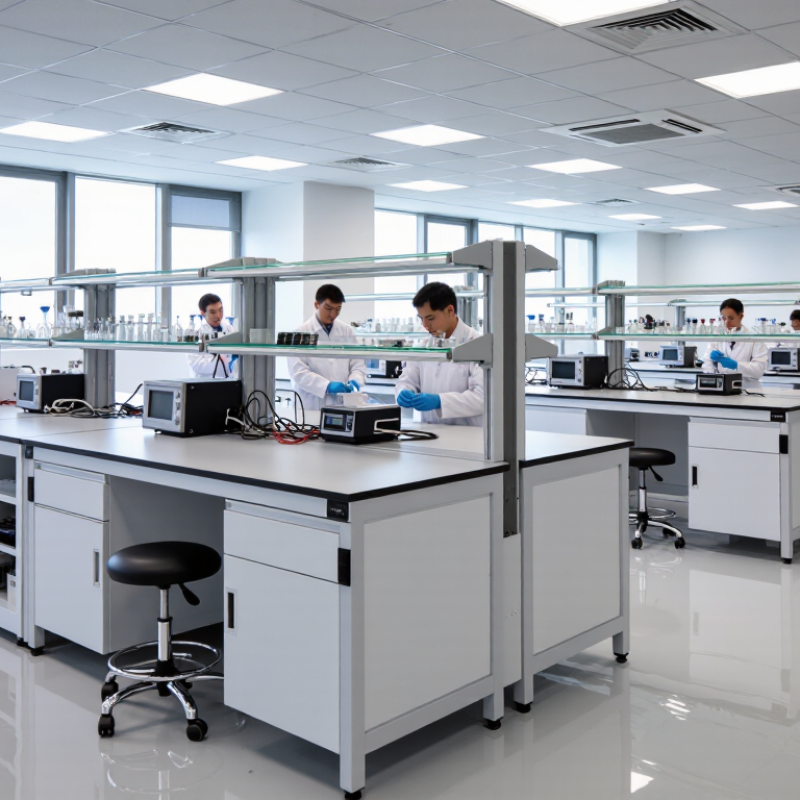
China Top Lab Workstations Manufacturers and Suppliers

Definition and Role of Laboratory Workstations

A laboratory workstation is a dedicated area where scientists perform testing, preparation, measurement, and documentation. It usually combines a durable work surface, storage, lighting, utilities, and safety features. Unlike ordinary office furniture, it must support controlled laboratory activities.

In daily use, the workstation helps organize instruments, samples, chemicals, and records. A well-planned layout keeps frequently used tools within easy reach. It also reduces unnecessary movement around sensitive equipment. For example, a technician may need a spill-resistant surface, grounded electrical outlets, and adjustable lighting during sample preparation. Ventilation may be essential when procedures create dust, fumes, or heat. However, one workstation cannot meet every laboratory need. Requirements differ between research, medical, educational, and industrial settings. This point is often underestimated.

Tips: Check load capacity, surface resistance, cable management, ventilation, and cleaning access before selecting equipment. Ask suppliers for material specifications and maintenance guidance. Test the layout with real instruments, not only drawings. Leave enough clearance for service work and emergency access. A crowded bench may look efficient, but it can slow work and increase mistakes.

Reliable manufacturers and suppliers should provide clear technical data, quality documentation, installation support, and responsive after-sales service. Their recommendations should match local safety requirements and the laboratory’s actual workflow. Buyers should also review user feedback and inspect sample construction when possible. Small details matter, such as sealed edges, stable frames, and smooth drawer movement. 天天乐购彩票


Types of Laboratory Workstations Available in China

China’s laboratory workstation market serves pharmaceutical, chemical, clinical, educational, and research facilities. Grand View Research estimates the global laboratory furniture market will grow at about 5.8% annually through 2030. This growth reflects demand for safer, flexible, and more ergonomic work areas.

Fixed steel workstations suit laboratories with stable equipment layouts and heavy instruments. Modular benches allow cabinets, sinks, power units, and service columns to be rearranged. Mobile workstations support shared rooms and temporary testing zones.

Wet-lab benches usually include chemical-resistant tops, raised edges, and easy-clean joints. Fume-hood workstations control hazardous vapors through local exhaust systems. Cleanroom workstations use smooth surfaces and limited particle-shedding materials. Biosafety cabinet stations add controlled airflow for biological procedures.

Different rooms require different protection.

MarketsandMarkets reported that laboratory automation is expanding as laboratories seek higher throughput and fewer handling errors. That trend increases demand for workstations with integrated power, data, gas, and equipment-support systems. However, a visually advanced workstation may still perform poorly if airflow, maintenance access, or user posture is ignored.

ISO 14644-1 classification also reminds designers that cleanroom performance depends on controlled particles, not appearance alone. In practice, Chinese suppliers should provide load calculations, material certificates, ventilation data, and installation records. Buyers should inspect cable routing and sealant quality before acceptance. Small details matter.

Key Features and Technical Specifications

China Top Lab Workstations Manufacturers and Suppliers

A reliable laboratory workstation begins with measurable specifications, not attractive drawings. Common frames use powder-coated steel or anodized aluminum, while stainless steel suits wet and corrosive areas. Check the steel thickness, weld quality, and load rating before purchase. A practical bench should support at least 300 kilograms per meter, depending on equipment weight. Adjustable leveling feet help maintain stability on uneven floors.

Worktop selection depends on daily procedures. Epoxy resin handles heat, moisture, and frequent cleaning. Phenolic surfaces reduce cost but may show wear sooner. For sensitive instruments, vibration control matters more than appearance. Ask suppliers for deflection data, surface resistance tests, and documented chemical compatibility. A workstation depth of 750 to 900 millimeters usually leaves enough room for instruments and cable access. Too much depth can make rear maintenance awkward.

Ventilation needs careful review. A local exhaust connection should match the room system, with airflow commonly verified by an anemometer during commissioning. Electrical modules may include grounded sockets, circuit protection, and separated data ports. Water fixtures should resist leakage and allow simple replacement. Experienced manufacturers provide drawings, material certificates, inspection records, and installation guidance. Still, specifications can look stronger than real performance. Measure twice. Visit a production site when possible, inspect sample joints, and test drawers under load. Even a well-designed workstation may fail if users overload shelves or ignore airflow requirements.

China Top Lab Workstations Manufacturers and Suppliers — Key Features and Technical Specifications

The chart compares commonly specified laboratory workstation dimensions. Modular workstations typically offer 1,200–1,800 mm widths, 600–900 mm worktop depths, and 750–1,050 mm working heights to support different laboratory layouts, equipment loads, and ergonomic requirements.

Leading Manufacturers and Suppliers in China

China Top Lab Workstations Manufacturers and Suppliers

China’s leading lab workstation manufacturers and suppliers now serve universities, hospitals, pharmaceutical facilities, and testing centers worldwide. A 2024 report from Grand View Research estimates steady growth in the global laboratory furniture market through 2030, driven by stricter safety requirements and expanding research investment. China’s broad metalworking and surface-treatment capacity supports customized benches, fume-resistant cabinets, and modular storage.

Reliable suppliers should provide documented load testing, material certificates, installation drawings, and clear warranty terms. Powder-coated steel, compact laminate, and stainless steel each suit different environments. For example, stainless steel handles repeated washing, while compact laminate offers better resistance to many laboratory chemicals. Suppliers familiar with EN 13150, SEFA guidance, and local electrical standards can reduce design errors. However, compliance claims still require verification. A certificate alone is not enough.

Tips: Request a sample corner joint and inspect its edge sealing. Ask for a factory quality report, not only product photographs. Compare lead time, replacement-part support, and packaging protection. The 2023 ASHRAE laboratory guidance highlights the importance of ventilation coordination, so workstation layouts must match airflow planning. In practice, the cheapest quotation can hide thinner steel, weaker hinges, or poor leveling feet. That deserves reflection. A capable Chinese supplier should explain these trade-offs clearly, communicate in measurable specifications, and support commissioning after delivery.

China Top Lab Workstations Manufacturers and Suppliers - Leading Manufacturers and Suppliers in China

Workstation Category Typical Structure Common Size Range Typical Load Capacity Common Materials Typical Laboratory Uses Relevant Requirements
Wall-Bench Workstation Single-sided bench fixed along a laboratory wall Depth: 600–900 mm; height: 750–900 mm Approximately 150–500 kg per linear metre, depending on construction Powder-coated steel, stainless steel, compact laminate, epoxy resin, or phenolic resin General laboratory work, sample preparation, analytical instruments Chemical resistance, stable leveling, safe cable and service routing
Island Workstation Freestanding double-sided bench accessible from both sides Width: 1,200–1,800 mm; height: 750–900 mm Approximately 250–800 kg per linear metre Steel frames with stainless steel, epoxy resin, ceramic, or compact laminate tops Teaching laboratories, research laboratories, collaborative testing areas Balanced frame design, anti-vibration performance, accessible utilities
Heavy-Duty Instrument Bench Reinforced frame with a rigid, low-deflection work surface Depth: 750–1,200 mm; custom lengths available Approximately 500–1,500 kg per linear metre, subject to engineering design Reinforced steel, stainless steel, epoxy resin, natural stone, or vibration-control surfaces Microscopes, balances, spectrometers, calibration equipment, and other sensitive instruments Deflection control, vibration reduction, equipment anchoring, and precise leveling
Height-Adjustable Workstation Manual or powered frame allowing seated and standing operation Working height commonly 650–1,250 mm Approximately 100–300 kg, depending on the lifting mechanism Powder-coated steel, stainless steel, compact laminate, or chemical-resistant resin tops Ergonomic sample handling, electronics testing, inspection, and instrument operation Overload protection, anti-pinch design, frame stability, and electrical safety
Mobile Workstation Work surface mounted on lockable casters for controlled movement Width: 600–1,500 mm; depth: 600–900 mm Approximately 100–350 kg, including distributed equipment load Powder-coated steel, stainless steel, high-pressure laminate, or phenolic resin Flexible testing areas, cleanroom support, maintenance, and temporary work zones Caster locking, corner protection, maneuverability, and secure utility connections
Cleanroom Workstation Low-particle, easy-to-clean construction with enclosed or open support frames Depth: 600–900 mm; dimensions configured to room classification Approximately 100–500 kg, depending on design and equipment 304 stainless steel, electropolished stainless steel, or non-shedding laminate Pharmaceutical, semiconductor, medical-device, and controlled-environment production Smooth cleanable surfaces, minimal particle generation, and compatibility with ISO 14644 environments
Wet-Chemistry Workstation Bench configured with splash protection, sinks, service fixtures, and chemical-resistant surfaces Depth: 750–900 mm; height: 750–900 mm Approximately 200–600 kg per linear metre Epoxy resin, ceramic, stainless steel, polypropylene, or chemical-resistant compact laminate Chemical analysis, wet processing, sample digestion, and solution preparation Chemical compatibility, spill containment, drainage, ventilation coordination, and safe utility placement

Note: Dimensions and load capacities are typical industry ranges for planning and comparison. Final specifications should be confirmed through structural calculations, laboratory risk assessments, equipment requirements, and applicable local standards.

Selection, Customization, and Quality Considerations

Selecting a lab workstation from China requires more than comparing prices. Start with load capacity, bench dimensions, chemical resistance, and user height. A steel frame may support heavy instruments, but poor leveling can cause vibration during sensitive measurements.

Ask suppliers for material certificates, welding details, surface-treatment specifications, and inspection records. Request photos of the actual production line, not only polished catalog images. Powder coating should resist common laboratory cleaners and remain even around corners. Check drawer movement, cable routing, and ventilation access before approval. Small gaps collect dust.

Customization is useful when the room has unusual columns, ceiling heights, or instrument footprints. Provide a measured floor plan with service points clearly marked. Suppliers can then adjust shelves, sinks, monitor arms, and electrical modules more accurately. Confirm tolerances in writing. A five-millimeter mistake can disrupt an entire installation.

Factory communication also matters. A capable technical team should explain limitations instead of promising everything. I have seen attractive layouts fail because doors opened into work zones. That detail was missed. Independent pre-shipment inspection can verify dimensions, weld quality, hardware, and packaging. Ask for sample approvals before mass production, especially for color and laminate texture. Delivery reliability depends on clear drawings, staged checks, and realistic lead times. Even experienced buyers should review the final design twice; assumptions are easy to overlook.

Inquiry Form